top of page


Stained Glass Windows
St. Boniface Church Stained Glass Windows
The parish of Saint Boniface, established in 1850, is a parish with deep roots in the early settlement years of Southern California, the Missions, and the German heritage of Anaheim. Several church buildings have served the community, but none is more recognizable and majestic as the current church, built in the early 1960′s.
The church in use today was the project of Monsignor John Quatannens who served as pastor of the parish from 1958 to 1971. Born in Belgium and a graduate of the American College of Louvain, Monsignor Quatannens’ European roots are evident in the architecture, style, and art chosen for Saint Boniface. European artists were commissioned to create the artwork for Saint Boniface– from the stained glass windows to the bells, to the grill work that once decorated the communion rail and the statuary.
Saint Boniface, much like the cathedrals and churches of old, is rich with art that functions beyond mere decoration. The colorful mosaics and stained glass windows educate, inspire, and inspire one to a deeper connection with the divine.
The crown jewels of the church building are the stained glass windows designed by Dutch artist Alex Asperlagh (1901-1984), a student of the Academie van beeldende kunsten in The Hague and were crafted locally in Altadena, CA using the European method of stained glass making.
Sixteen 12′ foot tall windows adorn the clerestory. The East clerestory windows depict the seven gifts of the Holy Spirit; the West clerestory windows depict the seven sacraments. Opposing windows depicting the Sacrifice of Abraham and the Sacrifice of Melchizedek decorate the sanctuary.
Each window is full of meaning, and small details are not haphazard; the windows are a catechesis rich in theology and symbolism. Contemplation fully appreciates the genius of the artist before these works of sacred art.
It’s an amazing sight to walk into the church and be taken by the beauty of natural light filtering through the windows gently bathing everything it touches in a kaleidoscope of color, a beautiful analogy of grace breaking through the darkness and bathing our existence with its radiance.
East Clerestory

Extreme Unction - Saint James the Greater
Saint James the Greater is portrayed here administering the Sacrament of Extreme Unction, or the Anointing of the Sick. It is unknown why the artist chose to depict Saint James the Greater rather than the younger James whose epistle is quoted. All the Apostles, of course, administered the same Sacraments, and so any could be portrayed here. It was James the Less, however, whom the Council of Trent called the promulgator of the Sacrament of the Anointing of the Sick.
In his Epistle, Chapter 5:14-15 we find the scriptural text most often referred to as proof of the biblical basis for this sacrament:
Is anyone among you sick? He should summon the presbyters of the church, and they should pray over him and anoint [him] with oil in the name of the Lord, and the prayer of faith will save the sick person, and the Lord will raise him up. If he has committed any sins, he will be forgiven.
In this window the elder St. James is shown ministering to a dying woman while her daughter weeps beside her bed. The tree showing through the window could signify life the fruit of newness, the doves peace, for all these are results of the sacred anointing.
Penance - Saint John Marie Vianney
With that, he breathed on them, and said to them, "Receive the Holy Spirit; when you forgive sins, they are forgiven, when you hold them bound, they are held bound." John 20:23
Saint John Vianney, know as the Cure of Ars, France, was one of the outstanding confessors among the saints. He lived from 1786 to 1859. He was a saint God raised up to counteract the apparent ruin of religion resulting from the French Revolution. A saint of the parochial clergy, he was known as well for his great common sense and his sense of humor, as for his evident sanctity and supernatural gifts. He was dull and unlearned as a seminarian, suffering from lapses of memory which made studying an overwhelming task. His holiness, however, sufficed in his superior's minds to warrant his ordination.
As a confessor, he spent the greater part of his day and night in the confessional, and people waited hours to confess to him and receive his advice and admonitions.
In our window the Cure's influence is particularly show in in the departure of the devil and in the devout posture of the penitent. The remission of sin is signified by the priest's uplifted hand.
The departing devil all aflame, is particularly dynamic in contrast to the static figures of the Cure and the penitent.
.png)

Holy Orders - Saint John Bosco
Saint John Bosco is known as the Apostle of youth. His priestly ministry was dedicated to showing boys the way to real success and union with God; in this work he fulfilled his ministry most perfectly because he was, for hundreds of boys, the representative of Christ, a bridge from earth to heaven, a Christ bearer whose interests and zeal was concentrated in God's honor.
This window illustrates an incident from his life. Don Bosco, as he was known, was preaching in the Torino marketplace (one of the market stalls can be seen behind him and a trades-flag above his head). He was talking to the two ruffians pictured with him. They sneered at his words, so Don Bosco said to them, "Do you not want to see the truth? What if you at once would not be able to see at all?" The blond boy laughed and suddenly became blind. This astonished the onlookers. The other boy, frightened, stares at the saint, while the woman in the foreground, representing the onlookers, begs Don Bosco to restore the boy's sight. He does so, but as a consequence the boy realized the seriousness of his words. It would be easy to presume that the boys joined Don Bosco's Oratory and took life a bit more seriously from that time on.
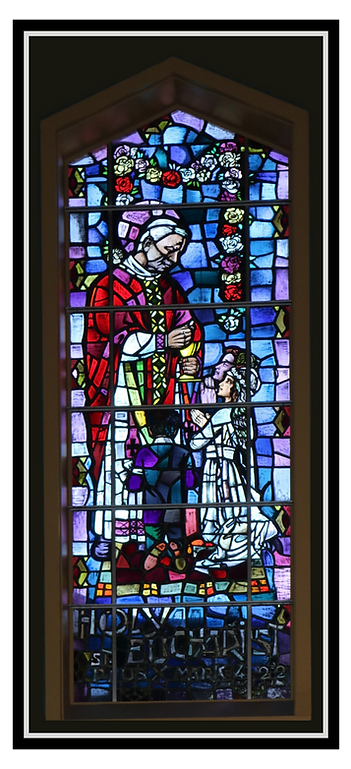
Holy Eucharist - Saint Pope Pius X
Born Giuseppe Sarto in a village near Venice, Italy, Pope Pius X, succeeded Pope Leo XIII as Supreme Pontiff. He introduced greater simplicity into the ceremonies of the Vatican, worked for reform in ecclesiastical legislation and better religious education for the laity and codified Canon Law. He is best remembered by the Church, however, for his decree of December 1906 permitting children to receive Holy Communion as soon as they were able to distinguish the Blessed Sacrament from ordinary bread.
He is thus pictured dressed in Mass vestment administering Holy Communion to three children. He is said to have remarked that Holy Communion is the shortest way to heaven and that the Church, the Mystical Body of Christ, should echo Christ's words, "Let the little children come to me and forbid them not." Holy Communion for children had been common from the early days of the church until the ninth century when the minimum age was raised to the early teens. Pope Pius X, then, reintroduced the "children's Communion" and the joy of the event is marked in the window by the garland of flowers in the background.
.png)

Confirmation - Saint Paul
And when Paul laid [his] hands on them, the holy Spirit came upon them, and they spoke in tongues and prophesied. Acts 19:6
Paul, known as Saul before his conversion, became one of Christianity's most influential missionaries. He embarked on numerous missionary voyages throughout the Mediterranean and his writings are in the canon of the Bible. He was beheaded in Rome during the persecution of the Christians under the Emperor Nero.
In our window, Paul is depicted in Ephesus where he had discovered that the disciples of Apollo have not been fully baptized into the Church; he proceeds to bring them into the Church through the "baptism of Jesus Christ" and lays hands on them. The Holy Spirit descends upon the one being confirmed.
Paul is seated, the posture of teacher. He wears a mitre and pallium signs of the office of bishop and shepherd.
A bow, arrows, and oak leaves are depicted above the figures. Our Bow today is the Holy Spirit and the arrows are the gifts of the Spirit, (1 Corinthians 12:1-11). The Lord takes aim into the darkness of the world with the gifts of his church. The oak was one of the several species of trees that were looked upon as the tree from which the Cross was made. Because of its solidity and endurance, the oak is also a symbol of the strength of faith and virtue, and of the endurance of the Christian against adversity.
Baptism - Saint Francis Xavier
Saint Francis Xavier lived from 1506 – 1552. He is known as the Apostle of the Indies. A native of Spain, he attended university in Paris and there met Saint Ignatius of Loyola, the founder of the Society of Jesus. Francis became one of Ignatius' first followers. In 1540 he was commissioned to go as a missionary to the East. He made stops in his journey all along the African Coast and in India preaching and baptizing converts to Catholicism. In Malay he met a Japanese whom he instructed and baptized; at this time he became determined to go to Japan. He arrived in 1549 and stayed for more than two years.
In this window, Francis is shown baptizing a Japanese prince. The details of the window are atmospheric. Francis has the austere, penitential look that was characteristic of him. He is associated with the Sacrament of Baptism because as a missionary he obeyed exactly the injunction of Christ, "Go and teach all nations, baptizing them in the name of the Father, and of the Son, and of the Holy Spirit."
.png)
.png)
Matrimony - Saint Elizabeth of Hungary
Saint Elizabeth 1207 — 1231, daughter of King Andrew of Hungary, at the age of thirteen married Louis, the ruler of Thuringia. Elizabeth was a beautiful bride who dearly loved her husband. Louis returned his affection with all his heart. Their marriage, though short, lasting only six years, was a happy one.
Saint Elizabeth was known for her generosity to the poor and sick, however her generosity was not favored by all. Prince Louis’ family thought Elizabeth was squandering the family fortune on the poor. Once when she was secretly taking food to the poor and sick, Prince Louis stopped her and looked under her cloak. Much to Elizabeth’s delight and Louis’ surprise the food she was carrying miraculously changed to roses.
Their marriage ended when Louis died of the plague. At that point she renounced the world, became a third-order Franciscan and devoted herself to the care of the sick until her death a few day before her twenty-fourth birthday.
“Elizabeth understood well the lesson Jesus taught when he washed his disciples' feet at the Last Supper: The Christian must be one who serves the humblest needs of others, even if one serves from an exalted position.
Elizabeth, Louis and their children are depicted in our stained glass window. In the background Wartburg Castle is depicted. It was here that she lived and built the hospital where she served the poor and ill. Notice the flowers on her dress; a reminder of the miracle of the roses.
West Clerestory
Council - St. Catherine of Siena
St. Catherine of Siena was a Dominican Sister of the fourteenth century who was famous for her insight and discretion, her holy boldness for the sake of God’s glory, and her eminent sanctity.
The gift of counsel enables the soul to distinguish not only right from wrong, but also the good from the better, and the better from the best, so that the quest is not only for obedience but perfection.
Catherine surely possessed such virtue to an extraordinary degree, and her gift of counsel manifested itself in the advice she gave to others. In this window we see Pope Gregory XI during the time of the Great Schism, and the Pope had removed the Holy See from Rome to Avignon, France, in protest against the uprising of the Italian cities. St. Catherine’s duty was to persuade the Pope to return to Rome and she went to Avignon, as we see in the window, to plead with the Pope. He returned to Rome and later commissioned her to go to Florence as his Ambassador to plead his cause there. She succeeded in reconciling Florence to the Holy See, though only for a time.
The cardinal in the window is possibly Robert of Geneva who led the Pope’s army into Florence. He was responsible for much bloodshed. His personal life was none too honorable either, and Catherine dared to denounce the scandals that further threatened the Church.
The unstable church at the top of the window is the St. Peter’s of those days and symbolizes the threat by schism and scandal to the Medieval Church.


Fortitude - St. Joseph
Fortitude is the courage to do what one knows is right and helps one overcome obstacles that hinder one from faithfully living out the relationship with God. St. Joseph is depicted as the model of this gift.
In our window, he is shown working at the carpenter’s bench. He stands strong, tall, and determined, all qualities that marked his life as he fulfilled his roles as husband to Mary and foster father to Jesus.
We do not hear much about St. Joseph in Scripture; however, his silence is eloquent in that it speaks of great fidelity to God’s will despite the obstacles he faced. His silent determination and heroic fidelity allowed him to face the controversy that surrounded his marriage, the journey to Bethlehem, facing rejection, providing for his family, and moving his family to protect them from a tyrannous murderer. He was a witness of faith not necessarily by what he said, but rather through his action. Joseph met each obstacle with strength and trust in God’s unfolding plan.
At the base of the workbench is a pot of flowering lilies. They are a symbol of virtue, purity, and obedience to God every step of the way. Behind him is the town of Bethlehem, city of his ancestor, King David. Through adoption, Jesus is the Son of David, the promised Messiah of a longing people.
Understanding - St. Augustine of Hippo
“The gift of understanding enables us to perceive the truth, not only to "assent" to it, but “see into” it. The gift clarifies truths of our faith and gives us insight into them. Now we see as in a glass, darkly; then face to face. But the gift “shines” that glass so that we see not so darkly.
St. Augustine of Hippo was a man who had known life from one side to the other. As a young man, he lived a worldly, licentious life and was converted through the prayers of his mother, St. Monica, and the sermons of St. Ambrose. After his conversion, he became a priest and later Bishop of Hippo, in Africa.
He became a great orator and later wrote his Confessions and City of God. God granted him tremendous insights into the truths of faith and the science of his spiritual life. He understood human nature, too, because of his former failings. The church has given him the title of “Doctor of the Church” because of his writings and the great contribution to understanding our faith.
In our window, Augustine wears the vestments of a bishop. He glances up and out the window; his expression is one of serenity and content. All signifies the inner vision he enjoys of the divine things he will one day see face to face.
The monk with him is his secretary.


Piety - St. Charles Borromeo
Piety according to St. Thomas, is the gift which inspires reverence for God, the Father of all, and which enables us to work good to all through that reverence. It is the habit of worship of God.
St. Charles Borromeo showed clear signs of this gift from youth, signs that were to be his most characteristic marks later in life. His uncle, Pope Pius IV, raised Charles to the cardinalate when Charles was only twenty three years old. Despite his high office, his concern lay with the poor. His reverence for the presence of God, whom he saw in the poor who gathered around him, led him to distribute his riches and to mingle with the simple people. He never refused audience and help to sinners, and he especially loved children. His principal work was the reformation of the clergy, who were living very comfortably at the time.
St. Charles’ gift of piety was complete, for his not only had a profound love of prayer, but this worship of God went out to all those who bore God’s image and likeness.
In our window, St. Charles is shown as the Cardinal Archbishop of Milan (the coat of arms of Milan is shown on the lower portion of the window) whose concern was the little ones, the children, those in sorrow, those suffering, and sinners. He holds a sick child in his arms who is perhaps a victim of the plague of 1576. The sick mother at his feet is an exact picture of human misery, and St. Charles’ expression is one of true compassion.
Knowledge - St. Thomas Aquinas
Knowledge is the gift of the Holy Spirit which enables us to judge rightly about matters of faith and action; knowledge about matters of belief; and also how to make the faith known; how to help others believe, and how to confute those who deny the truths of faith.
St. Thomas Aquinas, the great Dominican theologian, is one of the greatest minds in the history of the church to possess this gift in a high degree.
St. Thomas wrote Summa Theologica (The Summary of Faith), a compendium of the articles of faith with detailed explanation. He had been obsessed by the question, “What is God?” and in his search for the answer, he found God. He was bold in his use of his intellect, but underlying boldness was the humility and gentleness which added its own persuasion.
In our window we see Thomas, surrounded by his disciples, teaching the eternity of God. On his breast is the sun, symbol of his brilliance, and also of the fact that this revolved around his search for, and tremendous love of the True Sun, Jesus Christ. The escutcheon is, no doubt, that of Paris, where Thomas taught at the Sorbonne.
St. Thomas stands for all time as a model of reasoning faith.


Fear of the Lord - Moses
When Moses approached the camp, and saw the calf and the dancing, his anger burned, and he threw the tablets out of his hands, breaking them to pieces at the foot of the mountain. And he took the calf the people had made and burned it in the fire; then he ground it to powder, scattered it on the water and made the Israelites drink it. Exodus 32:19-20
By molding the golden calf and worshiping it, (lower left corner of the window) the Jewish people broke their covenant with God. Moses, anger making his figure mighty and dynamic, dashed the tablets of stone inscribed with the Ten Commandments. Moses showed both that the Israelites had broken the covenant and that the people were unworthy of the benefits of the law. Moses thus upheld God’s honor.
In the window, horizontal clouds harken to the fact that Moses’ meeting with God was hidden by a cloud, and they also signify the sublimity of Moses’ mission as a messenger to God’s people.
Moses’ violent actions, destroying the tablets of stone and the idol, too, awakened consciences in the people. They were humbled and stricken at the sight of their sin. The virtue of Fear of the Lord does the same for us. We see ourselves as we are before the face of God, sinners in need of reliance on the all-holy, all-merciful, and all just God, our loving God.
Wisdom - Mary, Mother of Jesus
“Woman, why do you involve me?” Jesus replied. “My hour has not yet come.” His mother said to the servants, “Do whatever he tells you.” John 2:4-5
Mary, the Mother of Christ, who is Divine Wisdom itself, is here depicted as the model of the virtue or gift of wisdom. Wisdom is the greatest of the Seven Gifts because it is the one which enables us to relish things divine. It helps us make a right estimate of things putting everything in its proper place, thus establishing true order and proportion.
Christians refer to Mary as the Seat of Wisdom because she was closely united with her son. The church applies to her the Scriptural text: “Wisdom has built herself a house.” Proverbs 9:1
In this window, we see Mary at the Wedding Feast of Cana, where Christ worked, at her bidding, his first public miracle. Pictured here, Christ is in conversation with the bride and the groom. Mary has already mentioned to Jesus that the young couple has run out of wine, and he has seemingly rejected her unspoken request. Her wisdom prompted her to see the value of the situation, caused her to approach the problem without emotion, and led her to cooperate in the design of God in instituting and blessing the state of marriage. Too, she knew her son’s will, which he could make something great out of a little thing.
Jesus, of course, did what his mother was confident he would; he changed water into excellent wine.

Sanctuary

Sacrifice of Abraham
“Do not lay your hand on the boy,” said the angel. “Do not do the least thing to him. For now I know that you fear God, since you did not withhold from me your son, your only one.” Genesis 22:12
Abraham's sacrifice was also a prototype of the sacrifice of Calvary. Abraham was willing to offer to God his only son, Isaac, as God had commanded him.
The Jewish people always sought to perfect their sacrifices. If it hadn't been for God's fifth commandment given to Moses, "You shall not kill", the Jews may eventually have arrived at what is a most perfect offering, human sacrifice. Although a human being's offering of himself to God is the most perfect sacrifice, God did not will this victim's destruction.
God would give this notion of substitution a truly redeeming value by allowing His only begotten Son to offer Himself in the place of sinful humanity. Isaac bore the wood to the place of sacrifice, as Christ bore His cross. He allowed this immolation of himself by his father, as Christ, too, would willingly obey His Father's command. There is one great difference, however, God spared Isaac, but He did not space His own Son. The sacrifice was completed on Calvary and is repeated daily on our altars.
What was almost a dogma of the Old Testament, that all things are cleansed by the shedding of blood, and there was no expiation without it, was applied by Christ. Jesus shed his blood, and the infinite merits of that sacrifice sealed God's covenant with humanity and repaired for sins of all humans.
Sacrifice of Melchisedek
Melchizedek, king of Salem, brought out bread and wine. He was a priest of God Most High. He blessed Abram with these words: “Blessed be Abram by God Most High, the creator of heaven and earth; And blessed be God Most High, who delivered your foes into your hand.” Genesis 14:18
Melchizedek, dressed in the robes of the High Priest offers an un-bloody sacrifice of bread and wine. Because he appears without known origin or end, he is thus the sign of the eternal priesthood of Christ. In the ordination rite the priest is told, "You are a priest forever, according to the order of Melchizedek," representative of Christ, the eternal High Priest.
The Old Testament bears witness to the obligation imposed on men to offer tithes of their possessions; unleavened bread was often presented as an offering. Such a bread was found in the hands of the High Priest, Melchizedek, with wine, the fruit of the vine.
The herald at the top of the window announces the significance of this sacrifice, its value as the prefigurement of the Holy Eucharist. So significant was it that Melchizedek is still mentioned in the Roman Canon of the Mass.
Melchizedek's name itself signifies king of justice, and he was king of Salem, (later Jerusalem), which means peace. Jesus Christ would establish the Eucharist in the forms of bread and wine and offer the eternal sacrifice on Golgotha.
Christ, through his salvific action becomes both priest and sacrificial victim. He is the Prince of Peace.

Thank you to Raymond Uribe for his insightful descriptions of the stained glass windows of St. Boniface Catholic Church. His interest in Sacred Art began when he was a child in his home parish of Saint Boniface and his interest grew as he began to understand the symbolism and meaning. As a seminary student at Saint John's in Camarillo, CA, he devoted time to researching the history and styles of sacred art and the beautiful sacred art of the College and Theologate chapels further nurtured Raymond's interest. Raymond is part of the staff of Loyola Institute for Spirituality in Orange, CA.
bottom of page