

Our Patron
Our Patron, St. Boniface
Born in Devon, England in 675, St. Boniface was baptized Wynfrith, which means "friend of peace," since he is the child of a Saxon father and British mother. Wynfrith was educated in the monastery; and after years of school and formation, was ordained into Benedictine Order.
In May 719, Pope Gregory II gave Wynfrith the new name Boniface and appointed him the mission of evangelizing Bavaria and Hesse. In 722, Pope Gregory II consecrated Boniface of the Episcopacy.
In 732, Pope Gregory III gave Boniface the Pallium, making him Archbishop of all of Germany.
The Christmas Tree Tradition
While traveling with a small party through the region of Lower Hesse, Boniface learned of a pagan community in the village of Geismar. The villagers would regularly gather around a massive, ancient oak tree known as the "Thunder Oak" to make human sacrifices—typically a child—to the Norse god Thor. Wishing to save the life of the innocent sacrifice and challenge pagan tradition, Boniface set out to strike down the tree, confident that the true God would protect him from any pagan wrath.
Boniface and his companions reached the village on Christmas Eve, arriving just in time to interrupt the grim sacrifice. Stepping forward, Boniface approached the gathering and boldly declared:
"Here is the Thunder Oak, and here the cross of Christ shall break the hammer of the false god, Thor."
With that, Boniface grabbed an axe and began chopping down the Mighty Thor's sacred tree. As the giant oak split and fell to form a cross, the astonished villagers saw that Boniface remained completely unharmed. Behind the fallen ruins of the oak stood a small, young evergreen fir tree. Pointing to it, Boniface turned to the crowd and said:
"This little tree, a young child of the forest, shall be your holy tree tonight. It is the wood of peace. . . . It is the sign of an endless life, for its leaves are ever green. See how it points upward to heaven. Let this be called the tree of the Christ-child; gather about it, not in the wild wood, but in your own homes; there it will shelter no deeds of blood, but loving gifts and rites of kindness."
Through this powerful moment, Germany's Catholic conversion began, and St. Boniface is widely credited with popularizing the evergreen tree as a Christian symbol—laying the groundwork for the modern Christmas tree.

St. Boniface felling Thor's Oak by E. Delahaye
Martyrdom
Even in his old age, Boniface’s missionary zeal never faded. In 754, when he was nearly 80 years old, he retired as Archbishop of Mainz to return to the mission fields of Frisia (modern-day Netherlands).
On Pentecost Sunday of that year, while Boniface and his companions were preparing to administer the sacrament of Confirmation to a large group of new converts near the town of Dokkum, an armed band of hostile pagans ambushed their camp.
When his protectors drew their weapons, Boniface stopped them, saying,
"Cease, my sons, from combat, for we are taught by Holy Scripture not to render evil for evil, but rather good."
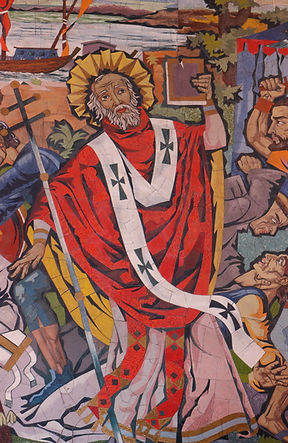
Boniface and 52 of his companions were martyred. As the fatal blow was struck, Boniface raised a heavy Gospel book above his head to shield himself, which was deeply sliced by the attacker's sword.
This very book, known today as the Ragyndrudis Codex, still bears the dramatic weapon cuts and is preserved as a precious Bonifacian relic in the Cathedral treasury at Fulda.

A passage from the Ragyndrudis Codex, featuring matching nail holes along the edges of every page
Resting Place
Following his death, St. Boniface's body was brought back to Germany, in accordance with his wishes. He was buried at the Abbey of Fulda, a monastery he had helped found. Today, his tomb rests beneath the high altar of the Fulda Cathedral and remains a major site of pilgrimage for Christians from around the world.

Crypt of Saint Boniface below the Cathedral of Fulda in Germany
Patronage and Legacy
Today, St. Boniface is remembered as the "Apostle of Germany" for his monumental role in shaping European history and bringing the Catholic faith to the Germanic peoples.
-
Feast Day: June 5th (the date of his martyrdom)
-
Patron Saint of: Germany, brewers, tailors, and the Diocese of Fulda.
-
Symbols in Art: An axe, a fallen oak tree, or a book pierced through by a sword.

Chapel of St. Boniface under the Cathedral in Fulda, Germany